
Prepare
October 12, 2026
It’s time to prepare.
The government has launched its Prepare campaign. This has advice on practical steps to take in the event of an emergency. Bear in mind that for many people some form of emergency is a certainty. What isn’t known is when it will come. Nor what form it will take. The government website lists an alarming array: animal and plant health; antimicrobial resistance; cold weather, snow and ice; cyber; droughts; fires in the home; flooding; infectious disease outbreaks; hazardous substance and radiation exposure; hot weather and heatwaves; overseas emergencies; phone and broadband outages; poor air quality and pollution; power cuts; storms; terrorism; water supply interruptions or outages; wildfires.
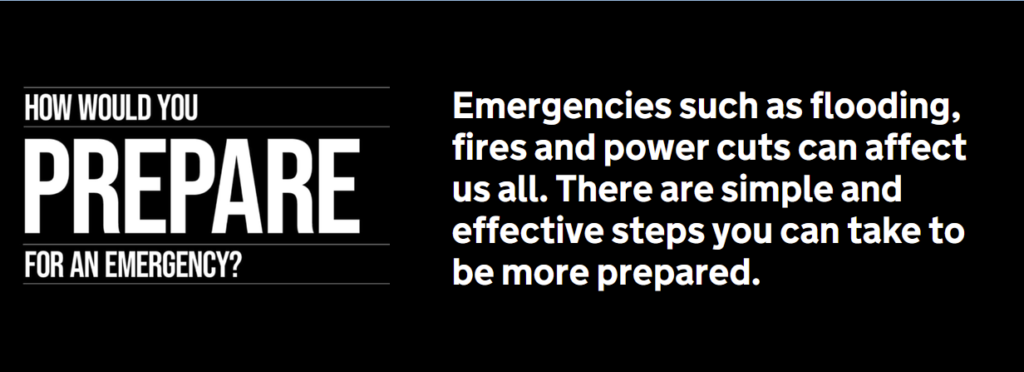
Of course, given we are experiencing an omni-crisis of disasters, the likelihood is that more than one may hit us at any one time, droughts, wildfires, poor air quality and water supply interruptions make unwelcome bed fellows. So do storms, power cuts and flooding.
Quite a number of the potential emergencies we face are, unsurprisingly, linked to the climate and nature crisis. It isn’t yet clear when or how we may be affected by escalating or novel diseases in the global north. In the global south it’s a different picture. In 2025, a study commissioned by Wellcome found that “climate change, poverty, and drug resistance are combining to create an escalating health crisis that could become a ‘creeping catastrophe’ if left unaddressed.”
As a way of preparing for disaster, the Prepare campaign brings to mind the government’s guidance in the 1980s ‘Protect and Survive’ booklets and films to help people survive a nuclear attack. These, however, were more alarming and spoke to the potential emergency people could face. No sugar coating the impact of a nuclear blast: The heat and blast are so severe that they can kill, and destroy buildings, for up to five miles from the explosion. Beyond that, there can be severe damage.
The idea in the guidance that you could protect yourself from radiation in a ‘fall out room’ and ‘inner refuge’ that you create from doors, furniture, bags of fabrics, sand, earth etc. is unrealistic, but it was all about doing whatever you could.
What’s interesting about the Protect and Survive campaign and its hard-hitting truth about the dangers of a nuclear strike is the impact it had. It awakened people to the dangers they faced. It stated that there was no safe area in the country that would be guaranteed to suffer the impact of a nuclear blast. As a result, it scared people. And as a result of that, some people became mobilised. It resulted in an increase in membership of groups such as the Campaign for Nuclear Disarmament (CND). It spawned a Protest and Survive counter-pamphlet that countered the idea that a nuclear strike was survivable, and set out with clarity the argument for nuclear disarmament.
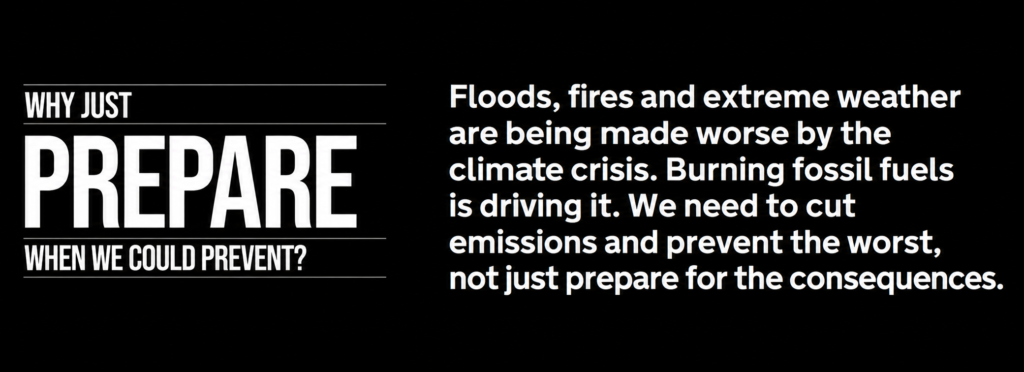
Right now, the government is giving us information that you could see as the sort of common-sense thing anyone should do given the likelihood of a disaster. What the government is not doing, is being truthful about the origin of the greatest crisis we face. In 1980 it was a nuclear strike. The government said so, even if the notion of surviving it is contestable. The Prepare campaign makes no mention of the climate crisis. No mention of carbon emissions. No mention of exceeding 1.5C of global warming. There’s no background information. No cause. It’s a hugely missed opportunity.
‘Prepare’ needs a truthful preface – because we are burning fossil fuels at an alarming rate, we are emitting excessive carbon into the atmosphere which is polluting the planet, causing climate chaos and resulting in disasters and emergencies all over the world, including the UK; this is not a warning about the future, it is a fact about the present!
Then, people will start to have the knowledge they need to connect the dots – we need to prepare because we are making a mess of things. Maybe we can then talk about clearing up the mess, not working out how many litres of water we need to store in case of an emergency.
Of course, the most obvious point is that we wouldn’t need to prepare, if the government and energy industries had properly prepared many years ago for the damage we are inflicting on ourselves and the planet. Imagine if in 1977, ExxonMobil executives had listened to their own scientists who predicted with alarming accuracy that burning fossil fuels would lead to 0.2C of global warming per decade. Imagine if they had alerted the world – now that would have been preparation!
From a local perspective we were not hugely involved in Love & Rage in London a few weeks ago. Plenty of other rebels were. If you want to find out what happened, then read A Rebel’s Tale on the XRUK website.
It’s been a long time since we had a local group meeting. We have one planned, in person, for Wednesday 21st October so please put that in you diary. We’ll confirm the venue in next week’s newsletter.
____________________
PEOPLE’S EMERGENCY BRIEFING
National Emergency Briefing screenings are still taking place with many happening locally. Nationally there have been over 3000 screenings. If you haven’t been to one, you want to go again, or you want to let other people know of the screenings, details of local events are given below.
If you are in a position to host a screening via an organisation you are part of please email xrwavereley@gmail.com and we’ll connect you with people who can help. By way of example, screenings are being hosted by churches, U3A groups and school parent teacher associations, amongst many others. There is no time limit as the expectation is that they will go on through the summer and into autumn.
The ask of everyone who reads this newsletter is send out information about the screenings generally, and the dates and times of local screenings specifically to as many people, groups and organisations as possible. Here is the pertinent information to.
General information about the National Emergency Briefing and the People’s Emergency Briefing screening:
- Information about the National Emergency Briefing can be found on their website.
- Information about the People’s Emergency Briefing film can be found here.
- An excellent trailer for the film can be seen here.
- To see the full list of screenings planned nationally please go to the NEB website’s screening map.
- To read testimonials about the screening go to the NEB website’s testimonials.
Details of local screenings:
Please go to the NEB screenings map for further details of each screening and information on how to book a ticket.
- Headley: Fri 9 October 2026 at 7.30pm, All Saints Church, GU358PP
- Camberley: Mon 19 Oct 2026 at 6.30pm, Login Lounge, Park Street, Camberley, GU15 3PL
- Chiddingfold: Friday 23rd October, Chiddingfold Village Hall, GU84QA
- Hook: Mon 26 October 2026 at 7pm, Elizabeth Hall, RG279HH (Rotary, Lions and public)
- Shackleford: Saturday 31 October at 10am, Shackleford Village Hall, GU8 6AE
- Medstead: Friday 20th November at 7pm, Medstead Village Hall, Roe Downs Road, Medstead, GU34 5LG
____________________
What’s on at the Climate Emergency Centres
To find out what’s happening at What Next? in Waverley, use this link.
To find out what’s going on at Zero Carbon Guildford, use this link.
To find out what the Alton Climate Action Network is up to, use this link.